An important message from Good Thinking
This is an archive of the Good Thinking website, which closed on 31 January 2026. The website is no longer actively maintained so the information may be out of date and certain features, such as the quizzes and free apps, are not available. If you need support for your mental health, please visit Every Mind Matters or Hub of Hope, or contact your GP, NHS 111, or the mental health team in your borough.


Approved by


LAST REVIEWED 20 March 2025
The impact of racial microaggressions on mental health
A guest blog by the Black Students Mental Health Project at London South Bank University (LSBU). This blog explains what microagressions, microassaults, microinsults and microinvalidations are, how they can affect black students' mental health, and how to address them with microaffirmations, microresistance and self-care.

Cheryl Taylor
LSBU Integrated Wellbeing Advisor and OfS Black Students Mental Health Project Officer







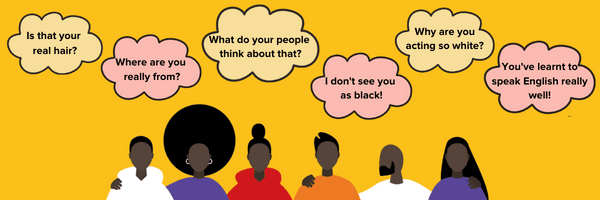
Types of microaggressions
Black people face microaggressions in a number of settings – in their places of learning, their places of employment, when they travel and where they shop. These microaggressions are mostly associated with stereotypes around them having less intelligence, being more likely to demonstrate violence or aggression, being a criminal and/or being lazy and therefore less hardworking than others.
The mental health impact of microaggressions
Repeatedly experiencing racial microaggressions reinforces and perpetuates oppression, including marginalisation.
When people encounter racial microaggression or a racially stressful event, it creates a cognitive load which requires them to ask themselves what just occurred. According to Kevin Nadal, a racial microaggressions expert, they engage in a three-part decision-making model in which they ask themselves:
- Did this microaggression really occur?
- Should I respond to this microaggression?
- How should I respond to this microaggression?
If they choose NOT to confront the situation, this may result in:
- Feelings of regret
- Remorse
- Isolation
- Guilt and/or shame
Choosing to confront the situation may result in them experiencing:
- A fear that they are negatively representing their social/racial group
- A fear of retaliation from the person(s) confronted (e.g. a student may fear that a professor will change their grade)
- A fear that they will be ineffective in challenging the microaggression
How to address microaggressions
As racial microaggressions attack the black person’s sense of identity, we need to take steps to address this. There are a number of ways to do this including developing racial pride and exploring the way we have been racially socialised. Other ways we can deal with this is through microaffirmations, microresistance and self-care.
Useful resources
This blog was written as part of the Office for Students' Black Students Mental Health Project at London South Bank University. Check out the full range of wellbeing resources available on the Good Thinking website.
Explore the resources >

References
- Pierce, C., & Carew, J. Pierce-Gonzalez, D., & Willis, D.(1978). An experiment in racism: TV commercials. Television and education, 44, 62-88.
- Sue, D. W., Capodilupo, C. M., Torino, G. C., Bucceri, J. M., Holder, A., Nadal, K. L., & Esquilin, M. (2007). Racial microaggressions in everyday life: implications for clinical practice. American psychologist, 62(4), 271.
- Nadal, K. L. (2011). The Racial and Ethnic Microaggressions Scale (REMS): construction, reliability, and validity. Journal of counseling psychology, 58(4), 470.
- Nadal, K. L., Griffin, K. E., Wong, Y., Hamit, S., & Rasmus, M. (2014). The impact of racial microaggressions on mental health: Counseling implications for clients of color. Journal of Counseling & Development, 92(1), 57-66.